Review · ROME
Rome: Appian Way & Roman Aqueducts Guided E-Bike Tour
Rome’s best cycling may begin only five minutes from the Colosseum, then quickly leave the city behind. This 27-kilometer e-bike ride follows the ancient Appian Way and the Roman aqueducts through open parks, old ruins, and surprisingly quiet countryside.
I especially like two things here: the route shows you a side of Rome that walking tours cannot reach, and the small groups, limited to 10 people, allow guides such as Nima, Pablo, Bita, and Aaliyah to keep a close eye on everyone. You get history, exercise, and fresh air in one outing.
The catch is the surface. Rough cobblestones, gravel, and broken ancient paving make this an intermediate ride, not a gentle cycle through a city park. You also spend about 40 percent of the route on city streets, where traffic can feel tense before you reach the quieter parks.
At a glance
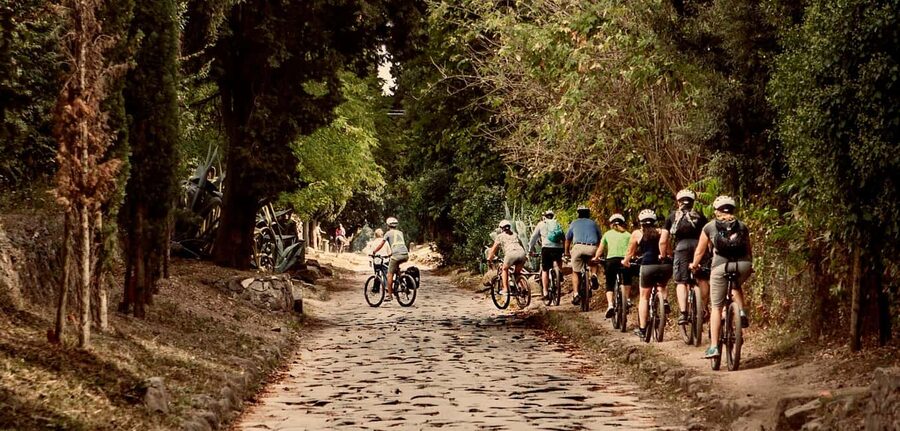
- Ancient road under your wheels: Ride sections of the 2,300-year-old Appian Way, with tombs and Roman ruins along the route.
- Huge aqueduct views: See the monumental arches at Parco degli Acquedotti and learn how Roman water systems worked.
- A real countryside escape: Caffarella Park and the aqueduct parks offer open space only a short ride from central Rome.
- E-bikes make the distance manageable: The electric assistance helps with hills and the 27-kilometer route.
- Small groups and active safety: Your guide leads the city sections, manages crossings, and checks that riders stay together.
- Bring comfort, not just cameras: Wear supportive shoes and be ready for gravel, rocks, and uneven stones.
Why this tour feels different from central Rome
Most first-time visits to Rome focus on the Colosseum, Roman Forum, Pantheon, and Trevi Fountain. Those sights deserve your time, but they also come with crowds, traffic, and a lot of standing. This ride changes the pace.
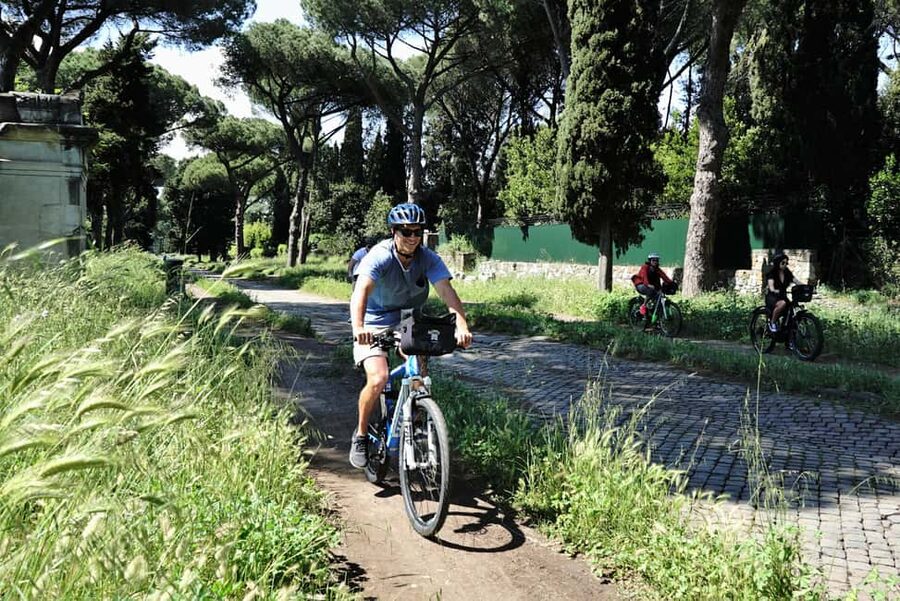
From the shop at Via Labicana 49, you make a short urban ride toward the southern edge of Rome. Then the setting opens up. Ancient ruins appear beside grassy paths, umbrella pines frame the road, and the noise of central Rome fades.
I like the contrast. You are still close to the city, but the experience feels less polished and more physical. You see Rome as a network of roads, farms, water channels, tombs, and scattered ruins rather than as a string of famous monuments.
The route covers about 27 kilometers in four hours. That includes stops for explanations and sightseeing, so you are not pedaling hard every minute. Still, you need reasonable comfort on a bicycle and enough stamina for a half-day outing.
More Historic E-Bike Tours in Rome
- Rome EBike Tour: Appian Way, Catacombs & Roman Aqueducts
★ 5.0 · 1,766 reviews - Rome: Appian Way, Catacombs, & Roman Aqueducts E-bike Tour
★ 4.9 · 1,421 reviews - Rome: Appian Way, Catacombs & Roman Aqueducts Top EBike Tour
★ 4.9 · 101 reviews
Leaving Via Labicana and crossing Rome
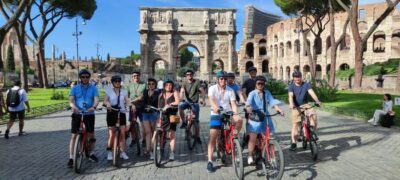
The meeting point is the tour shop at Via Labicana 49, about a five-minute walk from the Colosseum. This is handy if you are already sightseeing nearby, though you should allow time to get fitted for your Cannondale e-bike, helmet, and handlebar bag.
The bikes have anti-puncture tires and comfortable saddles. The electric motor is useful rather than theatrical. It takes the edge off hills and helps you maintain the group’s pace, especially if you do not ride often.
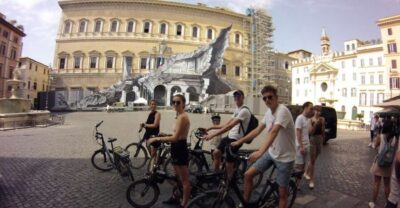
Your guide gives you a briefing before departure. That matters because the first and last sections use carefully selected city streets, but they are not traffic-free. Guides such as Nima, Pablo, Fabio, and Bita have been praised for helping riders through crossings and keeping the group calm and together.
You should not expect a fully protected cycle path from the shop to the countryside. Rome is Rome. Cars and intersections are part of the connection between the central meeting point, the Appian Way, and the aqueduct parks.
The Aurelian Walls and Rome’s southern edge
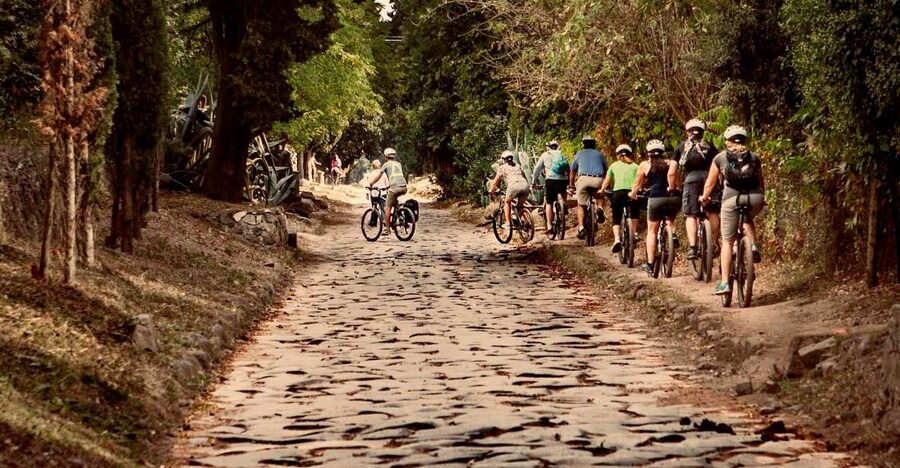
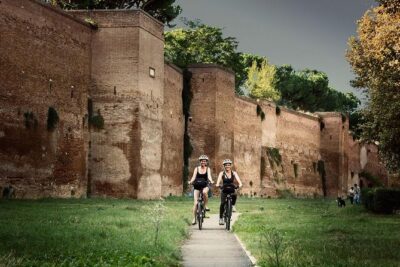
The Aurelian Walls help mark the transition between modern Rome and the city’s ancient defensive boundary. You see how large Rome was and how its outer edges were built to protect the imperial capital.
This stop is more useful as part of the wider route than as a long standalone visit. The guide’s explanation gives context for what follows: the ride is not simply a scenic bike trip, but a journey through the old roads and infrastructure that supported Rome’s growth.
The early city riding also gives you time to get used to the bike. If you have never used an e-bike, do not worry, but pay attention to the controls and braking. A previous rider described the bikes as easy to use even for first-time e-bike users, while another found the handlebars too low and experienced shoulder discomfort.
That is a good reminder to ask for an adjustment before leaving. A comfortable fit matters more on a four-hour ride than it does on a quick rental.
Catacombs, tombs, and the ancient Appian Way
The Catacombs of Rome are part of the sightseeing route, but this experience is primarily a cycling tour rather than an underground catacomb visit. You should expect to see the area and hear about its place in Rome’s early Christian story, not assume that a guided interior tour is included.
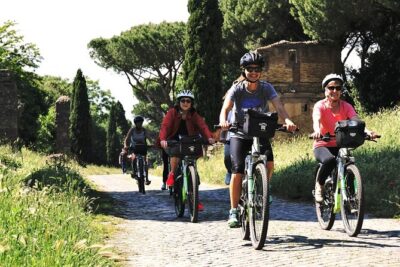
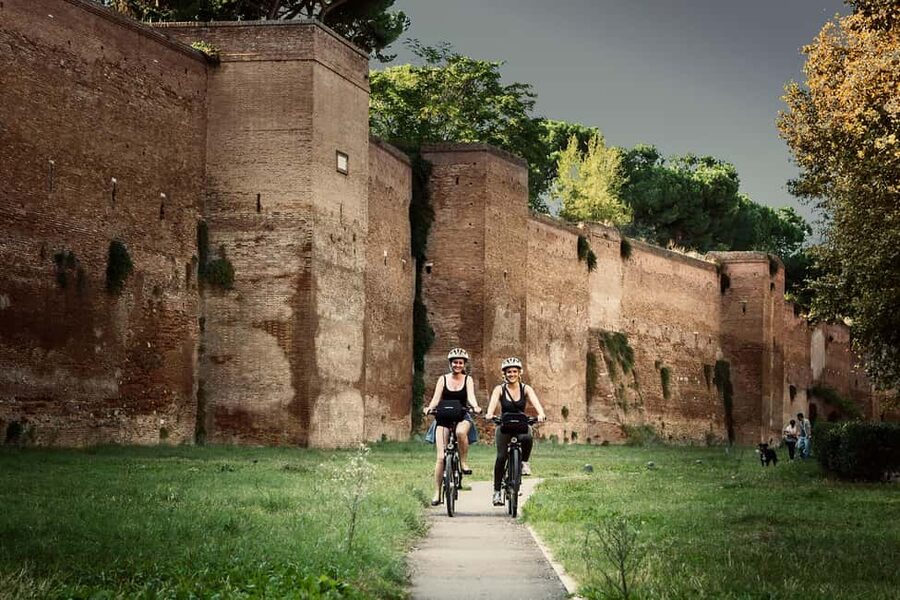
The great prize comes next: the Appian Way. The road began more than 2,300 years ago and connected Rome with southern Italy. Riding along its old paving gives you a direct sense of how transport worked in the ancient world.
It is also the roughest part of the outing for some riders. Ancient stones do not behave like modern pavement. The surface can be rocky, uneven, and jarring, particularly if you are unused to off-road cycling.
The electric motor does not smooth the road. It only helps you pedal. You still need to steer carefully, keep your hands steady, and accept a slower pace over the rough sections.
For me, that is part of the appeal. The Appian Way is not a museum floor or a restored avenue made for easy strolling. You feel the age of the road through the bike, and that makes the setting more memorable. If you want a smooth ride, this is the wrong outing. If you like a little adventure with your archaeology, it works well.
More Appian Way rides around Rome:
- Rome: Appian Way & Aqueducts E-Bike Tour (Catacombs & Food)
★ 4.9 · 1,498 reviews - Appian Way Aqueducts Bike Tour (Catacombs & Lunch Option)
★ 5.0 · 975 reviews - Appian Way, Catacombs and Aqueducts Park Tour with Top E-Bike
★ 5.0 · 735 reviews - Rome: Appian Way E-Bike Tour Catacombs, Aqueducts & Picnic
★ 4.6 · 727 reviews
The Circus of Maxentius and the Tomb of Cecilia Metella
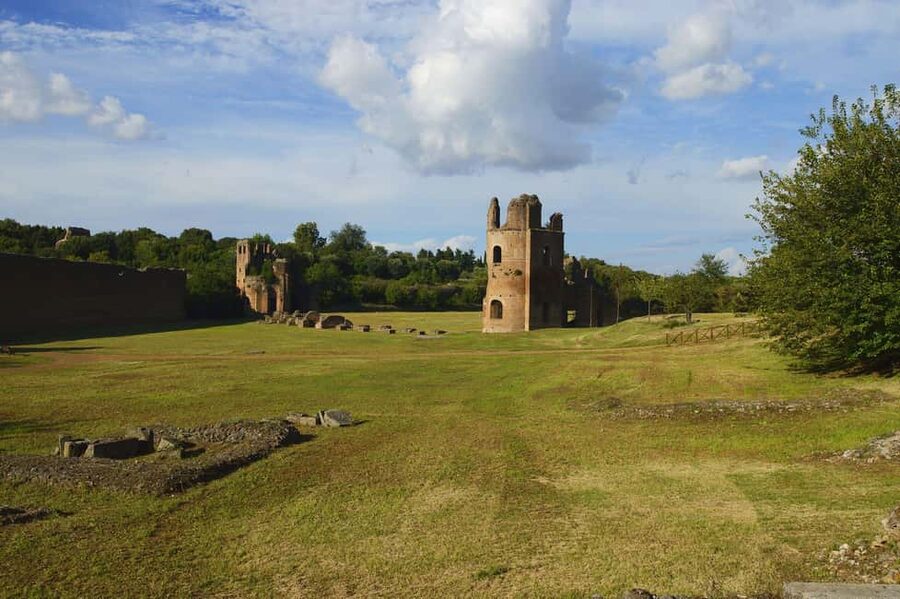
The Circus of Maxentius is one of the major Roman ruins along the route. The complex once included a large racing venue and related imperial buildings. From the bike route, you get a sense of its scale and position in the Appian Way setting.
The ruins are especially effective because you see them outside the packed center of Rome. There is room to pause, listen, and take photographs without trying to peer over a crowd.
The Tomb of Cecilia Metella adds another layer to the road. Monumental tombs lined the Appian Way, turning the route into both a transport corridor and a public display of wealth and status.
Your guide fills in these connections during the stops. The best guides on this route do more than name each ruin. They explain why the road was built, how Roman power extended beyond the city, and how the sites fit together.
The tour’s historical talks are a strength, but keep your expectations realistic. This is not a long lecture at every monument. You receive short explanations along the ride, followed by time to look around and take pictures.
Parco degli Acquedotti and Roman engineering
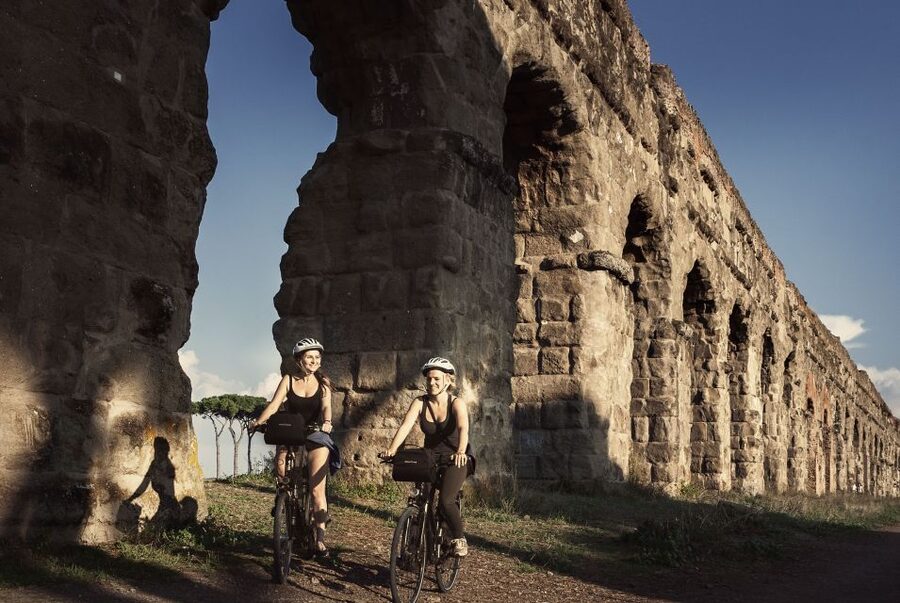
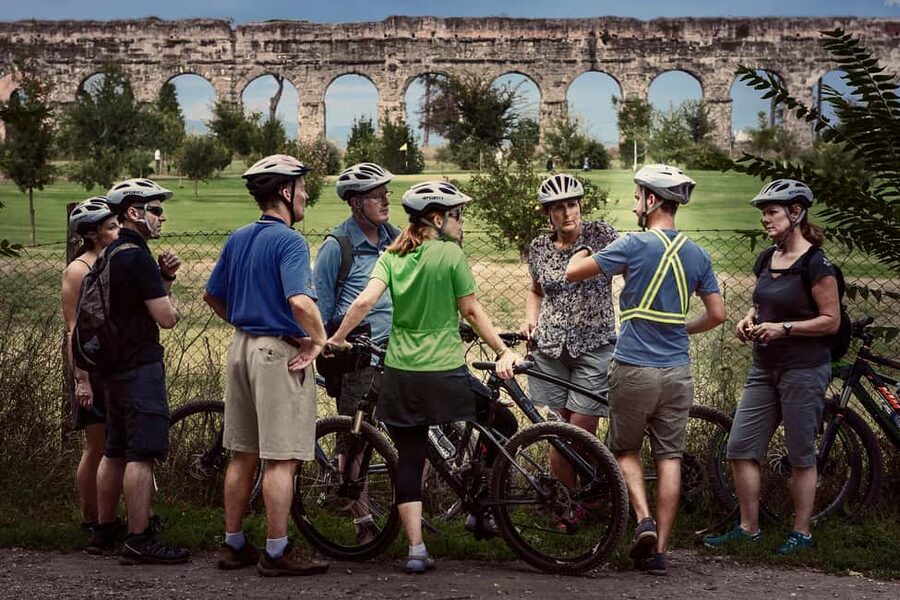
The aqueduct section is the visual high point. At Parco degli Acquedotti, long lines of arches cross the open ground, making Roman engineering easy to understand at a glance.
The Romans built aqueducts to carry water over long distances using carefully planned gradients. Here, you can see why the system was so powerful. The arches are not isolated fragments inside a museum. They run through the countryside as part of the setting.
This is where the e-bike earns its keep. The route lets you cover distance between major sights without wearing yourself out before the end. You can stop beneath or beside the aqueducts, hear how the water system worked, and take photographs with the arches extending behind you.
One especially memorable detail from the route is the Aqua Felix water. On a hot day, you might have the chance to cool off with water from this ancient supply system. Do not count on it as the main feature, but it gives the aqueduct stop a direct, refreshing connection to Roman engineering.
The park can feel almost wild compared with the streets near the Colosseum. That contrast is the reason I would choose this tour after a day or two of central Rome sightseeing.
Caffarella Park and the return ride
Caffarella Park gives you another wide-open section of the route. The park preserves an unusually open part of Rome, with paths, fields, ruins, and a slower rhythm than the historic center.
This is the stretch where you most clearly understand the phrase Roman countryside. You are still within the city’s wider area, but the ride feels far from monuments and traffic. The route through the park is also part of the 60 percent that takes place off-road.
The surface remains variable. You may ride gravel, packed paths, and uneven ground, so comfortable shoes and sensible clothing are more useful than stylish city footwear. A previous rider in her 60s described the rocky sections as challenging but manageable, which is a fair description of the route.
After the park and aqueduct sections, you ride back toward Via Labicana 49. The return is not simply a repeat of the morning. You reconnect with urban traffic, so your guide again plays an important role in road positioning and crossings.
What the e-bike changes
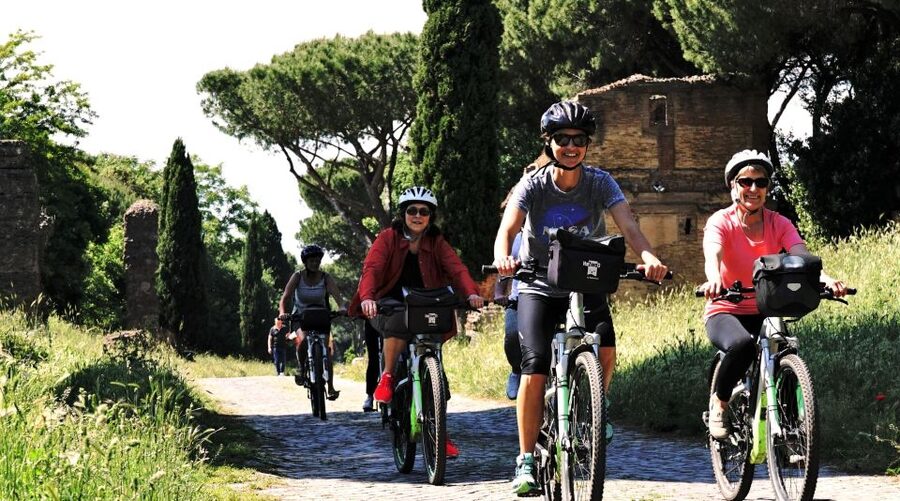
The e-bike does not turn the tour into a passive sightseeing ride. You still pedal, steer, brake, and handle rough surfaces. What it does is reduce the strain caused by hills, distance, and the need to keep moving with a group.
That makes the outing suitable for people who are active but not regular cyclists. Several riders in their 50s and 60s found the electric assistance made the ride practical, and families have used the bikes with teenagers.
The tour is classed as intermediate. That rating is important. You should already feel comfortable riding a bicycle, especially on uneven surfaces and in a group. The route becomes challenging with a child seat or child extension.
Children under 1 year cannot take part. Children aged 1 to 4 can ride in a child seat, up to 49 pounds or 22 kilograms, at no extra charge. Ages 5 to 8 use a child extension, while children 9 and older can ride a correctly sized e-bike.
The equipment has a maximum rider weight of 300 pounds, or 136 kilograms. Helmets are mandatory for everyone.
Price, group size, and overall value
At $85 per person, this is not the cheapest way to see Rome, but the price is fair for a four-hour guided outing with a quality e-bike, helmet, water bottle, handlebar bag, and a route that links several distant sites.
You are paying for more than bike hire. A guide deals with the urban riding, sets the pace, explains the ruins, and leads you through parks that would be awkward to connect on your own. The small-group limit of 10 also matters. You are less likely to get spread out, and it is easier to ask questions during the stops.
The value is strongest if you want active sightseeing and would otherwise skip the Appian Way or aqueducts because of distance. It is weaker if you mainly want long, quiet stops at each ruin. The four-hour schedule keeps moving, and a meaningful part of the time is spent listening to explanations or managing the route.
Free cancellation is available up to 24 hours before departure, and you can reserve now and pay later. Starting times vary, so check availability when you book. Hotel pickup and drop-off are not included.
A minimum of four participants is required. If that number is not reached, you are offered another option or a full refund.
Who should book this Appian Way ride?
I would book this for someone who has already seen the headline sights and wants a different side of Rome. It is also a strong choice for families with older children, active couples, and anyone who prefers moving through history rather than standing in one place.
You will get the most from it if you:
- Feel comfortable on a bicycle
- Can handle gravel, stones, and uneven paving
- Want Roman history beyond the Colosseum and Forum
- Like open-air scenery and active tours
- Are willing to ride through some city traffic
- Value a guide who manages logistics and safety
I would think twice if you have balance problems, dislike rough roads, or want a gentle city cycle. The route is not fully off-road, and the traffic sections cannot be removed because they connect the main sites.
The guides speak English, Italian, German, French, Spanish, or Dutch. Specific guides praised by name include Nima, Cas, Fabio, Aaliyah, Pablo, Bita, Zac, Davide, Ana, Linda, and Ali. The quality of the outing depends partly on how well your guide balances safety, history, and the pace of the group, so it is worth asking questions and speaking up if the bike needs adjustment.
Should you book it?
Yes, if you want to see Rome’s ancient infrastructure in its original setting and do not mind a rough ride. The Appian Way, Circus of Maxentius, tombs, aqueducts, and Caffarella Park create a varied half-day route that feels far removed from central Rome.
Book it with realistic expectations: this is an intermediate bike trip with 40 percent city riding and 60 percent off-road riding. If that sounds appealing, $85 is a solid price for the equipment, guide, small group, and access to places that are difficult to connect on foot.
FAQ
Where does the Appian Way e-bike tour begin?
The tour begins at the operator’s shop at Via Labicana 49, about a five-minute walk from the Colosseum. It returns to the same location.
How long is the tour?
The tour lasts four hours and covers about 27 kilometers.
How much of the route is off-road?
About 60 percent of the route takes place off-road in parks and on historic paths. The other 40 percent is in the city, including the connections between the Appian Way and the Aqueducts Park.
Is this tour suitable for beginners?
The tour is rated intermediate. E-bikes help with the distance and hills, but you should be comfortable riding a bicycle on gravel, rocky paths, uneven stones, and city streets.
Are children allowed to join?
Infants under 1 year cannot participate. Children aged 1 to 4 can use a child seat up to 49 pounds or 22 kilograms. Children aged 5 to 8 use a child extension, and children aged 9 or older can ride a properly sized e-bike.
What is included in the price?
The price includes a Cannondale e-bike with anti-puncture tires and a comfortable saddle, a professional guide, a mandatory helmet, a handlebar bag, and a biodegradable bottle of water. Hotel pickup and drop-off are not included.
New e-bike tours around Rome
- Rome E-Bike Tour: Roman Castles, Villages and Lake Views★ 5.0 · 2 reviews
- E-bike tour in the center of Rome★ 3.8 · 9 reviews
- Rome E-Bike Tour: Ultimate Street Food and Market Feast★ 4.9 · 50 reviews
- Best of Rome Electric Bike Tour★ 4.6 · 3 reviews
- Rome: E-Bike Tour on the Appian Way to Castel Gandolfo and the Lake★ 5.0 · 3 reviews
- Rome: Private Appian Way & Albano Lake Full-Day E-Bike Tour★ 5.0 · 2 reviews
- Rome: Appian Way, Aqueducts & Catacombs (Small Group or Private)★ 5.0 · 103 reviews
- Rome E-Bike Small Group Tour of the Appian Way with Private Option★ 5.0 · 130 reviews
Rome E-Bike Tours, side by side.
Rome EBike Tour: Appian Way, Catacombs & Roman Aqueducts
Read our review →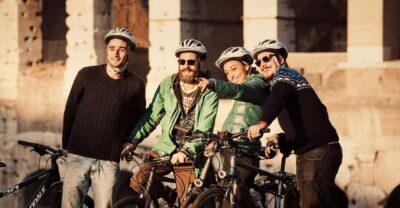
Top Highlights & Hidden Gems Tour by Cannondale E-Bike
Read our review →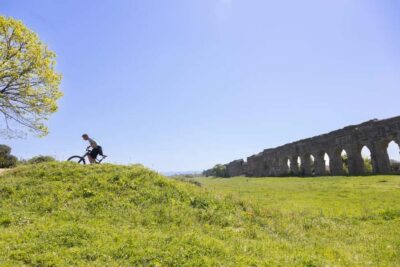
Appian Way & Aqueducts E-Bike Tour (Catacombs & Food)
Read our review →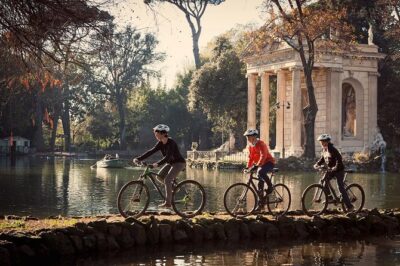
Rome City Small Group Bike Tour with quality Cannondale EBike
Read our review →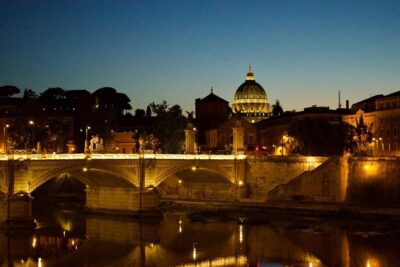
Rome by Night – Ebike Small Group Tour – Food and Wine (Option)
Read our review →