
Review · ROME
Appian Way, Catacombs and Aqueducts Park Tour with Top E-Bike
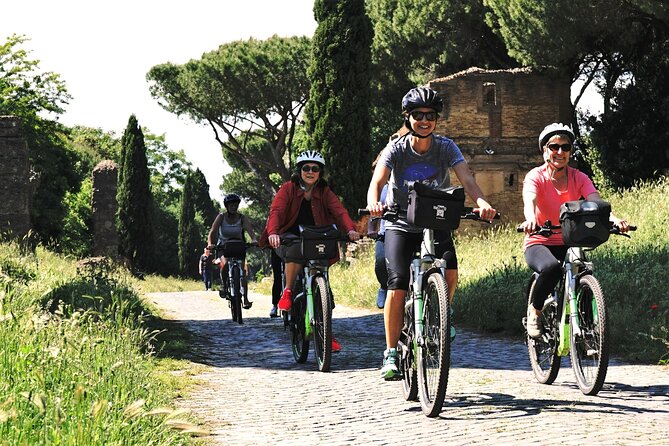
The best thing about this tour is its reach. In one long ride, you move from Rome’s traffic to the ancient Appian Way, underground burial chambers, Imperial ruins, open fields, and towering aqueducts. An electric-assist bike turns a 27-kilometer route into a manageable day rather than a punishing workout.
I like the small maximum group of 10, which gives guides such as Arina, Bita, Claudia, and Fabio room to explain what you are seeing and keep the group together. I also like the choice between a focused 4-hour outing and a fuller 6-hour version that includes a guided catacomb visit and Villa dei Quintili.
The catch is that this is not a beginner cycling trip. About 40 percent of the route uses city streets, some paths are narrow, and 60 percent is off-road over bumpy ground. You need to feel steady on a bike, and Sunday crowds can make the parks harder to ride.
Key points to know before you book
- Ride 27 kilometers beyond central Rome: The route links the Appian Way, catacombs, Imperial ruins, and Aqueducts Park in one outing.
- Choose your level of history and riding: The 4-hour tour covers the main route, while the 6-hour tour adds a 45-minute guided catacomb visit, Villa dei Quintili, and the Baths of Caracalla.
- Expect real cycling, not a gentle sightseeing loop: City traffic, tight paths, uneven surfaces, and park crowds require confidence.
- Electric assistance saves your legs: The bikes make long distances and modest inclines easier, but they do not remove the need to steer and balance.
- Small groups help: A maximum of 10 people means better contact with the guide and a safer pace than a large bike convoy.
- Weekdays are the smarter choice: Sundays can bring crowds of walkers and cyclists to the Appian Way and Aqueducts Park.
Why an e-bike is the right way to reach ancient Rome
Rome’s ancient southern fringe is spread out. Walking from the city center to the Appian Way, then continuing to the aqueducts, would take too much time and energy. Public transport does not give you a simple, direct way to connect all these places either. The bike solves that problem.
The tour covers about 17 miles, or 27 kilometers. The electric motor helps with the distance, especially after several hours of riding, but you still pedal, brake, steer, and manage the bike. I would call the physical level intermediate, exactly as the operator does. It suits someone who rides a bike competently, even if that person does not cycle regularly.
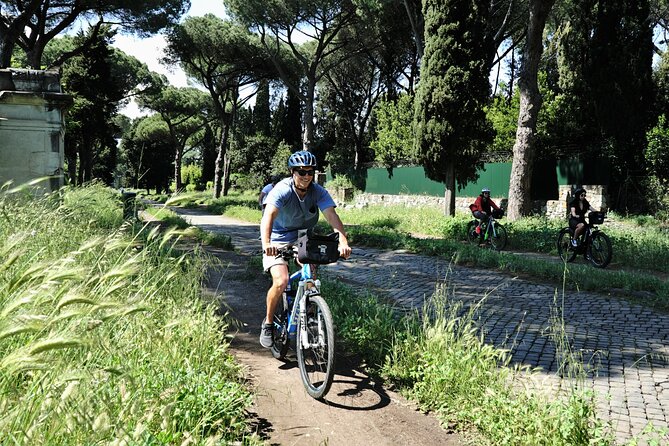
The route is split between city and park riding. Around 40 percent takes place on carefully chosen Rome streets. Traffic is unavoidable because you must cross town to connect the Appian Way Park with Aqueducts Park, so the experience is not entirely pastoral. The remaining 60 percent has no traffic, but it can be rough and narrow.
The bikes come with anti-puncture tires, a helmet, a front bag, and a biodegradable water bottle. The equipment has a 300-pound, or 136-kilogram, weight limit. Children from ages 5 to 8 can use a child extension, while children 9 and older can ride a correctly sized e-bike on their own. The route is difficult with a child seat or child extension, so families should think carefully about the youngest rider.
More Appian Way rides around Rome:
- Rome EBike Tour: Appian Way, Catacombs & Roman Aqueducts
★ 5.0 · 1,766 reviews - Rome: Appian Way & Aqueducts E-Bike Tour (Catacombs & Food)
★ 4.9 · 1,498 reviews - Rome: Appian Way, Catacombs, & Roman Aqueducts E-bike Tour
★ 4.9 · 1,421 reviews
From Porta San Sebastiano to the ancient Appian Way
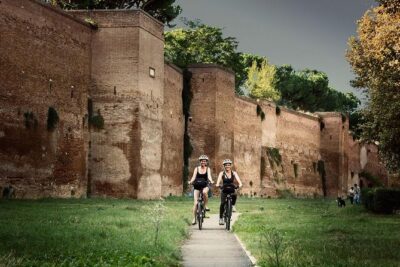
The ride begins at Via Labicana 49, a central meeting point near public transportation. From there, you head toward Porta San Sebastiano, one of the grand gates in Rome’s third-century Aurelian Walls. It is a fitting exit from the modern city: within minutes, the urban setting begins to thin out.
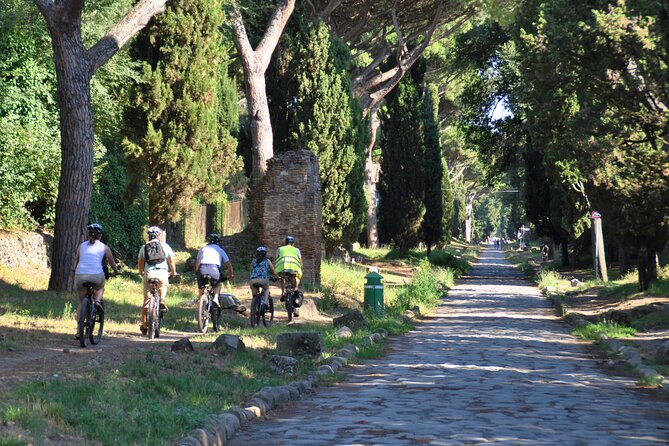
The first look at the Appian Way can feel almost understated. A normal Roman street gradually becomes an ancient road lined with stones, ruins, and open countryside. This change is part of the pleasure. You are not simply dropped beside one famous monument. You watch Rome fade behind you as the road takes over.
The Appian Way was one of the Roman world’s major routes, and its surviving stones make the ride feel unusually direct. You are moving along an actual ancient thoroughfare rather than viewing Roman history through a museum display. That authenticity is the main reason to choose this excursion.
Do not expect a perfectly smooth cycle path. The old road and nearby park tracks can be bumpy. One parent found the route ideal for teenagers but wished for more stops to take photographs, since stopping safely while riding was not always easy. If you want a picture at every ruin, this may feel brisk. If you prefer to keep moving while a guide explains the setting, the pace makes sense.
Catacombs of San Callixtus and San Sebastiano
The catacombs are the most enclosed and atmospheric part of the day. In the 4-hour version, you pause near the Catacombs of San Callixtus and contemplate the enormous underground burial complex, associated with roughly half a million burials. This shorter tour does not include the full guided visit.
The 6-hour version is the better choice if the catacombs are a main reason you are booking. It includes a 45-minute guided visit to the second-century Catacombs of San Callixtus, with time to understand how the underground chambers functioned and why they became so important to early Christian Rome.
The setting is not for everyone. Underground passages can feel tight, and the longer visit may be uncomfortable if you dislike enclosed spaces. One less positive experience involved arriving at a busy catacomb tour with a large queue and a crowded underground group. That possibility is worth keeping in mind, even though the bike group itself is capped at 10.
On Wednesdays, the plan changes. The 4-hour tour does not include the San Callixtus stop, while the 6-hour tour visits the Catacombs of San Sebastiano instead. Wednesday tours can also run 30 minutes longer, making the schedules approximately 4.5 and 6.5 hours.
Circus of Maxentius and Cecilia Metella
The ride continues to the Circus of Maxentius, part of a fourth-century Imperial complex that also included a villa and mausoleum. The circus was a venue for chariot racing, and its remains give you a useful sense of how much space Roman public entertainment required.
This is a short stop, about five minutes in the stated route plan, so you should not expect a long archaeological visit. Its value is in the wider story. The Appian Way was not only a road lined with tombs. It passed major estates, monuments, and Imperial projects, all spread through a setting that feels far removed from central Rome.
The Mausoleum of Cecilia Metella and the Castrum Caetani provide one of the road’s most recognizable sights. The first-century funerary monument is large, well preserved, and dedicated to Cecilia Metella, a young woman from a patrician family. The nearby medieval fortress complex adds another layer to the site.
I like this part of the route because the monuments appear in open space rather than behind a dense city block. You get the scale of the tomb and road together. Still, the listed stop is brief, so the guide’s explanation matters more than a long period of independent exploration.
More e-bike tours around Rome:
- Rome: Top Highlights & Hidden Gems Tour by Cannondale E-Bike
★ 4.9 · 1,760 reviews - Rome City Small Group Bike Tour with quality Cannondale EBike
★ 5.0 · 1,380 reviews - Rome by Night – Ebike Small Group Tour – Food and Wine (Option)
★ 5.0 · 1,275 reviews - Rome by Night: E-bike Small Group Tour -Food & Wine (Option)
★ 4.9 · 1,233 reviews
The 6-hour route earns its extra time
If you have room in your Rome schedule, the 6-hour tour offers a fuller sense of the area. Its major addition is Villa dei Quintili and Santa Maria Nova, a sprawling second-century private villa once owned by two extremely wealthy brothers. The site shows how Imperial privilege extended beyond palaces and forums into huge countryside estates.
The villa stop is especially useful for people who have already seen the Colosseum and central monuments and want a broader picture of Roman life. The Appian Way was a corridor of power, wealth, burial, transport, and water supply. Villa dei Quintili helps connect those pieces.
The longer outing also includes the Baths of Caracalla, viewed from what the tour describes as the best vantage point. The baths were not merely places to wash. They were central to social life, and the ruins help explain the public scale of Roman bathing culture.
You should choose the 6-hour option for the additional sites, not because the ride itself becomes more comfortable. It is a longer physical day, and the route still includes city streets and uneven park tracks. The reward is a much broader circuit with more time devoted to the catacombs and Imperial Rome.
Aqueducts Park and Rome’s open countryside
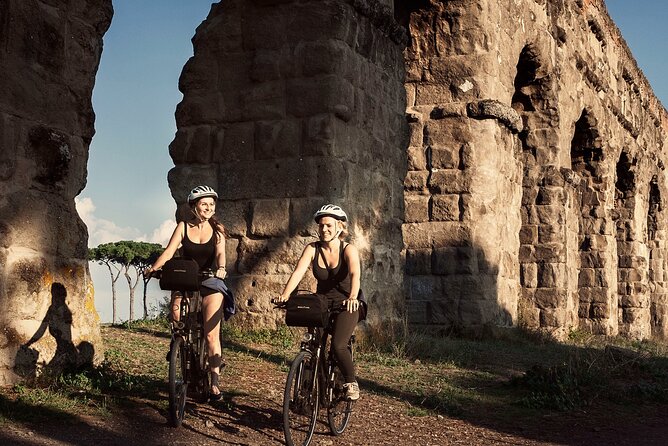
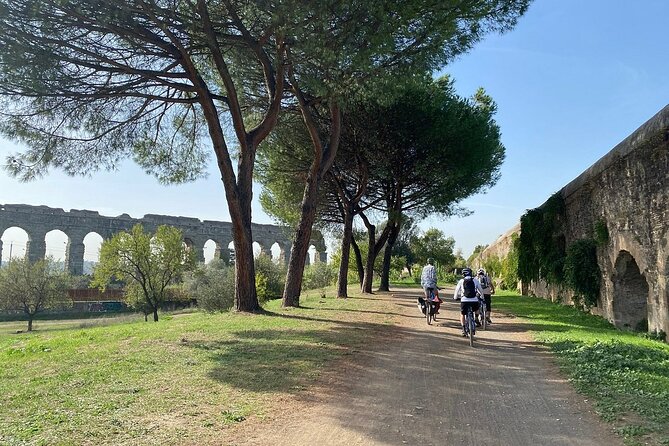
Aqueducts Park is the visual high point for many people. Massive arches cross the open park, showing the scale of the system that brought water into Rome through underground channels and elevated structures. The aqueducts are easy to appreciate from a bike because you can travel beneath and alongside them rather than view one fragment from a crowded sidewalk.
The setting changes again here. The route passes through green valleys and low hills on Rome’s outskirts, with sheep grazing in the fields. It is a sharp contrast to the city center and one of the tour’s most useful surprises. You see a side of Rome that is close in distance but far removed in mood.
This is also where weather and crowds matter. A rainy day can turn the ride into a memorable adventure, but wet paths and rough surfaces will not suit everyone. On Sundays, local walkers and cyclists fill parts of the park. That can make maneuvering stressful, especially when riding close behind other members of your group.
For the calmest experience, I would book a weekday if possible. You will still share the parks with other people, but the route should feel less crowded than on a popular Sunday.
Guides, pace, and group size
The guide can make or break a cycling tour. The most praised leaders on this route include Arina, Bita, Claudia, Fabio, Francesca, Han, Khalid, Lorenzo, Stefan, and Zac. The recurring strengths are clear: good historical explanations, a friendly manner, attention to safety, and an ability to manage different riding speeds.
A group of up to 10 is a sensible limit. It allows the guide to stop, explain a monument, check the riders, and answer questions without turning the day into a long wait. Families with teenagers especially benefit from this format. Several family groups found the e-bikes easy to use and the tour more engaging than another day of walking through central Rome.
The ride is intentionally controlled. One person found the pace too slow, averaging about 6 miles per hour, and felt the close spacing between bikes could become awkward. That criticism is important. A guided group cannot ride like a solo cyclist, and the need to keep everyone together means you may spend stretches riding slowly.
That pace also has a safety purpose. The guide must handle city traffic, narrow paths, pedestrians, and riders with different abilities. If you want speed or freedom to explore alone, rent a bike independently. If you want a planned route with historical context and someone leading you through unfamiliar streets, the group format is more useful.
What the $102.79 price buys you
At $102.79 per person, this is not the cheapest way to ride around Rome. The value comes from the distance covered, the quality of the e-bike, the guide, and the access to sites that are awkward to connect on your own.
You are paying for a half-day or full-day route that links several separate areas. A taxi or several public transport journeys could become expensive and time-consuming, while walking would sacrifice too much of the Appian Way and Aqueducts Park. The 6-hour version offers the strongest value if you want the catacomb visit and Villa dei Quintili.
The price does not include food or drinks. You can buy refreshments along the route, and suitable breaks are available, but bring a little cash or plan ahead. The supplied water bottle is useful, though it should not replace your own planning for a long ride.
Gratuities are optional. Free cancellation is available up to 24 hours before the start time. The tour requires at least four participants, so a booking can be canceled if the minimum is not met, with an alternative or full refund offered.
Who should book this Rome bike tour
I would choose this experience if you have at least two days in Rome and want time away from the Colosseum, Vatican, and crowded historic center. It is particularly good for active families with older children, couples who enjoy seeing a lot in one day, and repeat visitors looking for a different side of the city.
It also suits people who like history best when it is tied to places and movement. You are not just hearing about Roman roads, burial customs, water engineering, Imperial estates, and public baths. You are riding between them and seeing how they fit into the wider Roman world.
I would hesitate if you are not confident on a bike, have back or neck problems, or dislike uneven surfaces. The e-bike reduces exertion, but it does not remove the physical demands of balancing and steering. A child seat or extension makes the route harder, not easier.
Should you choose the 4-hour or 6-hour tour?
Choose the 4-hour version if you want the Appian Way, a glimpse of the catacombs, the Circus of Maxentius, Cecilia Metella, and Aqueducts Park without giving up most of your day. It is the practical choice for a packed Rome schedule.
Choose the 6-hour version if the catacombs matter to you, or if you want Villa dei Quintili and the Baths of Caracalla added to the route. The extra two hours create a fuller archaeological experience and make the price easier to justify.
My advice is simple: book the 6-hour ride on a weekday if you have the time and can handle a moderately physical day. Pick the 4-hour option for a shorter introduction, but do not mistake it for a casual spin around town. Either version gives you a memorable way to reach ancient Rome’s far edges, provided you are comfortable riding in traffic and over rough ground.
FAQ
Where does the tour begin?
The tour begins at Via Labicana 49, 00184 Rome, Italy. The activity ends back at the same meeting point.
How long does the tour last?
The standard choices are approximately 4 or 6 hours. On Wednesdays, the route can take about 30 minutes longer, making the tours approximately 4.5 and 6.5 hours.
How far do you ride?
You cover about 17 miles, or 27 kilometers, during the tour.
How much of the route is off-road?
About 60 percent of the route takes place in parks and off-road areas. Around 40 percent uses city streets to connect the Appian Way Park with Aqueducts Park.
Is the catacomb visit included?
The 6-hour tour includes a 45-minute guided visit to the Catacombs of San Callixtus. The 4-hour tour includes only a short pause near the catacombs, and on Wednesdays that stop is not included. On Wednesdays, the 6-hour route visits the Catacombs of San Sebastiano instead.
What is included with the e-bike?
The tour includes a quality e-bike with anti-puncture tires, a helmet, a front bag, and a biodegradable water bottle. A local guide leads the tour.
Can children join the tour?
Children ages 5 to 8 can use a child extension. Children 9 and older can ride an appropriately sized e-bike independently. The route is difficult with a child seat or child extension.
Is the tour suitable for beginner cyclists?
The tour requires an intermediate level of cycling ability and is not recommended if you are not self-confident on a bike. You will encounter city traffic, narrow paths, and bumpy off-road surfaces.
What happens if the tour does not reach its minimum group size?
The tour requires at least four participants. If it is canceled because fewer than four people are booked, you will be offered an alternative experience or a full refund.
New e-bike tours around Rome
- Rome E-Bike Tour: Roman Castles, Villages and Lake Views★ 5.0 · 2 reviews
- E-bike tour in the center of Rome★ 3.8 · 9 reviews
- Rome E-Bike Tour: Ultimate Street Food and Market Feast★ 4.9 · 50 reviews
- Best of Rome Electric Bike Tour★ 4.6 · 3 reviews
- Rome: E-Bike Tour on the Appian Way to Castel Gandolfo and the Lake★ 5.0 · 3 reviews
- Rome: Private Appian Way & Albano Lake Full-Day E-Bike Tour★ 5.0 · 2 reviews
- Rome: Appian Way, Aqueducts & Catacombs (Small Group or Private)★ 5.0 · 103 reviews
- Rome E-Bike Small Group Tour of the Appian Way with Private Option★ 5.0 · 130 reviews
Rome E-Bike Tours, side by side.
Rome EBike Tour: Appian Way, Catacombs & Roman Aqueducts
Read our review →
Top Highlights & Hidden Gems Tour by Cannondale E-Bike
Read our review →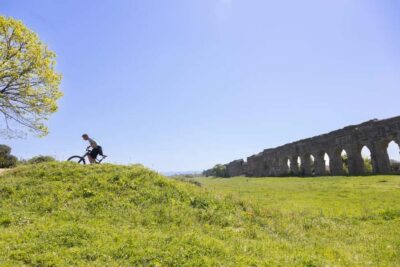
Appian Way & Aqueducts E-Bike Tour (Catacombs & Food)
Read our review →
Rome City Small Group Bike Tour with quality Cannondale EBike
Read our review →
Rome by Night – Ebike Small Group Tour – Food and Wine (Option)
Read our review →
This ride also appears in