
Review · GERMANY
Best of Munich Electric Bike Tour
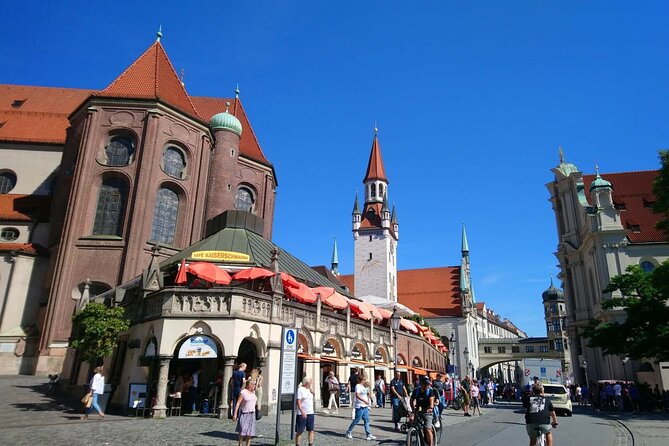
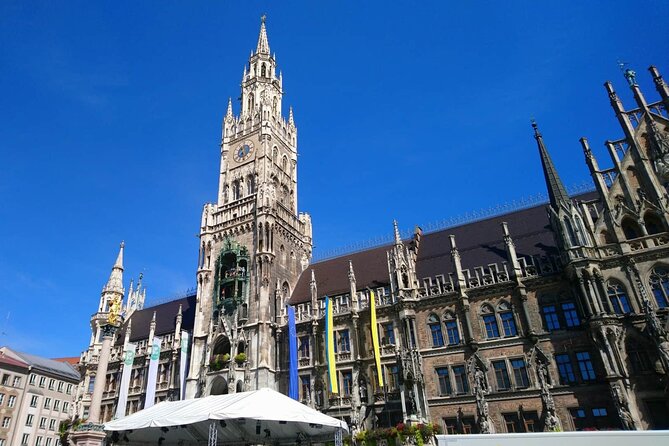
Munich reveals itself quickly from a bike seat. In about four hours, you move from grand royal squares and art museums to the leafy English Garden, a famous beer garden, river surfers, and the city’s central food market. The route gives you a useful first look at Munich without making you plan every turn.
I especially like the wide range of sights and the way the electric bike keeps the ride easy. I also like the guides’ practical touch: Canaan, Rob, Susanna, Karl, Mark, and Dan are praised for clear historical stories, safe riding, and good restaurant and museum tips. The main thing to consider is group size. Up to 20 people may ride together, and one guide has a lot to watch in city traffic.
Key points to know before you ride
- A four-hour overview: You cover royal Munich, the Nazi-era past, museums, parks, markets, and the Isar area in one outing.
- The electric bike helps, but Munich is fairly flat: You’ll stop often, so the motor is useful rather than essential for many riders.
- A beer garden visit is built in: The stop at Biergarten am Chinesischen Turm lasts about 40 minutes, with food and drinks paid separately.
- History is central: Königsplatz, the Führerbau, Odeonsplatz, the Residenz, and Ohel Jakob Synagogue give the route real depth.
- The pace is active but manageable: You ride, stop, listen, and walk around sights. Good general fitness helps.
- The tour ends where it begins: Meet at Karlsplatz 4, near public transportation, and return there after the ride.
Why this bike tour works well for a first look at Munich
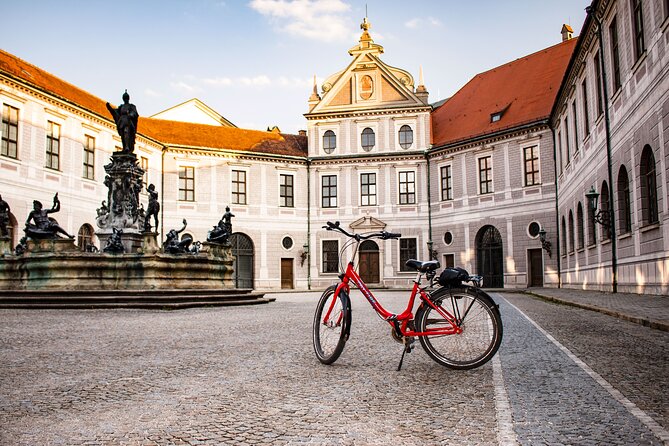
Munich is easy to explore on foot in the center, but the city’s major sights spread beyond the old town. This route links Maxvorstadt, the royal center, the English Garden, the Isar, and the market district without asking you to master public transportation on your first day.
The bike also lets you see the relationship between places. Königsplatz is not just an isolated square. It sits within the Kunstareal, Munich’s museum quarter. The English Garden is not just a park. It connects the city center with the river and the elegant eastern districts.
Your guide gives the route its shape. The strongest guides on this experience are described as friendly, funny, careful, and able to explain difficult parts of German history in a clear way. Canaan receives especially strong praise for safety and historical detail, while Susanna is noted for a well-timed ride. Rob is praised for useful local suggestions, and Karl and Dan for making the city feel approachable.
The route is conducted in English. The maximum group size is 20, though the group may include standard bicycles as well as electric bikes. That matters because the experience can feel less personal when the group is full, especially on busy streets.
More e-bike tours around the world:
- 3-Hour Porto Highlights on a Electric Bike Guided Tour
★ 5.0 · 4,392 reviews - Lisbon: Hills, Alfama, and Mouraria Tour by Electric Bike
★ 4.8 · 3,438 reviews - Athens Scenic Electric Bike Tour with optional Acropolis visit
★ 5.0 · 3,350 reviews
Karlsplatz to Maxvorstadt: fountains, French connections, and museums
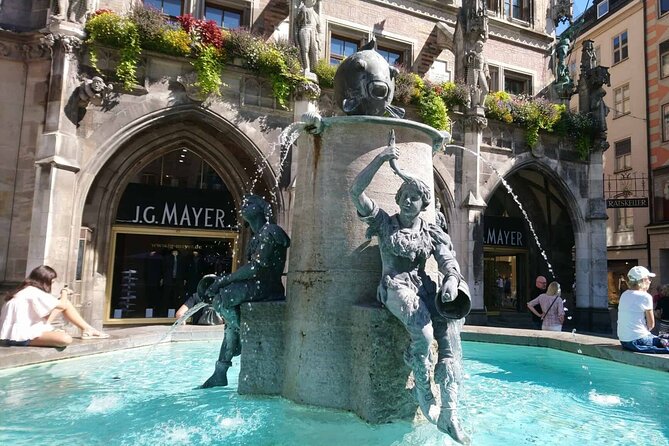
The meeting point is at Karlsplatz 4. From there, the ride reaches the Wittelsbacherbrunnen, a grand Neo-Classical fountain near Lenbachplatz and Maximiliansplatz. Built between 1893 and 1895, it presents water as a primal force. It is a quick introduction to Munich’s taste for monumental public art.
Karolinenplatz follows. This open square uses a radiating design known as the Strahlenplatz motif and reflects Bavaria’s political connection with France in the early 19th century. Its name honors Queen Caroline of Bavaria. You get about five minutes here, enough for a short explanation and a look around rather than a full visit.
Königsplatz is one of the route’s first major highlights. Its Neo-Classical buildings include the Propyläen Gate, the Glyptothek, and the Staatliche Antikensammlungen. You are in the middle of Munich’s museum quarter, and the square gives you a strong sense of the city’s 19th-century ambition.
The stop is brief, around five minutes, so don’t expect to enter a museum. Instead, use the guide’s explanation to decide if you want to return later. This is one of the tour’s useful habits: it gives you a map of Munich’s choices, not just a string of photo stops.
Facing Munich’s Nazi past at the Führerbau and Odeonsplatz
The Führerbau is one of the more serious stops. Built from 1933 to 1937, it was used by Adolf Hitler and remains in its original location. The building now houses the University of Music and Performing Arts Munich.
You will not spend long here, but the stop helps connect Munich’s elegant streets with its role in the Nazi period. That contrast is important. The route does not present the city as only palaces, beer, and pretty gardens.
At Odeonsplatz, the historical layers become even sharper. The square was developed in the early 19th century and is framed by the Theatine Church, the Feldherrnhalle, and the former Odeon concert hall. It was also the scene of the 1923 Beer Hall Putsch, when a fatal gun battle ended Hitler’s march.
This is a good place to listen closely. A brief stop can cover architecture, royal planning, and the political history of the 20th century. The guide’s skill matters here, and the best feedback for this experience focuses on guides who explain facts with stories instead of simply naming buildings.
Art, royalty, and gardens around the Residenz
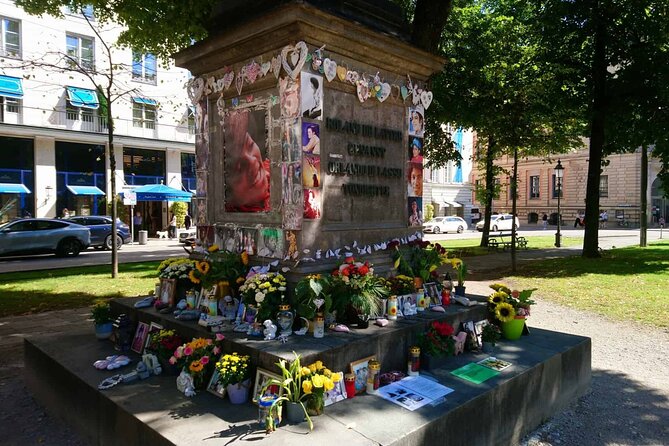
The Alte Pinakothek is one of the world’s oldest art galleries and holds major Old Master paintings. The tour pauses outside for about five minutes. If you enjoy European painting, note this location for a later visit because the bike tour cannot do justice to a full museum collection.
The Pinakothek der Moderne presents modern and contemporary art, works on paper, design, applied arts, and architecture in one complex. It is a useful counterpoint to the Alte Pinakothek. Together, the two stops show how Munich moves from royal and religious art toward modern design and ideas.
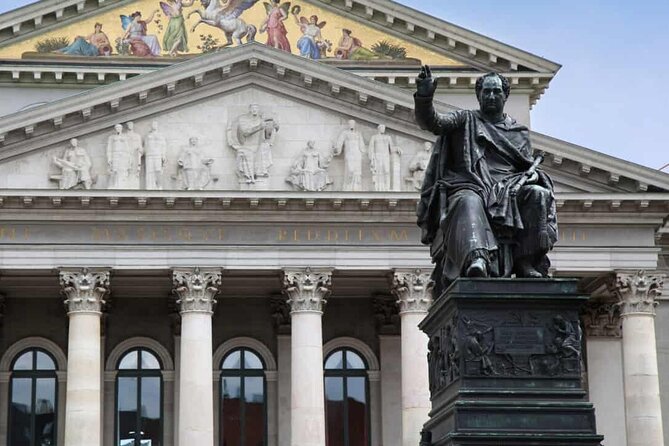
The Residenz München was the city palace of the Wittelsbach rulers of Bavaria. It is Germany’s largest city palace and now contains grand rooms, architectural displays, and former royal collections. Again, the stop is short. Think of it as a preview, not an interior tour.
The Hofgarten sits beside the Residenz and leads toward the English Garden. Its Italian Renaissance design dates to 1613 through 1617, with a central pavilion dedicated to Diana. This is one of the calmer parts of the ride and a good change from the heavy political history of the earlier stops.
The Bayerische Staatskanzlei comes next. The building was created around the central dome of the former Bavarian Army Museum, which had been built in 1905 and destroyed during World War II. The current structure dates from 1989 to 1993. It is a useful example of how Munich has rebuilt and reused important civic spaces.
Same saddle, a different route:
- Porto: City Highlights 3-Hour Guided Electric Bike Tour
★ 4.8 · 3,092 reviews - Red Rock Canyon eBike Half-Day Tour
★ 5.0 · 1,870 reviews - Hidden Kyoto E-Biking tour
★ 5.0 · 1,843 reviews - Rome EBike Tour: Appian Way, Catacombs & Roman Aqueducts
★ 5.0 · 1,766 reviews
The English Garden and a proper Bavarian beer stop
The English Garden is one of the world’s largest urban public parks, covering about 370 hectares. Its informal style was inspired by English garden design rather than formal geometric planning. Ten minutes here gives you a taste of the park, though you will not explore every corner.
The main pause comes at Biergarten am Chinesischen Turm. The beer garden has about 7,000 seats and has operated under the same management since 1974. Hofbräu beer is served here, and the stop lasts around 40 minutes.
This is where the tour feels most distinctly Bavarian. You can order a traditional beer or food, sit at shared tables, and enjoy a break from the saddle. Food and drinks are not included, so budget for your own order. If you do not drink alcohol, the stop still works as a rest and meal break.
The time is long enough to make the stop useful, but it can affect the total sightseeing balance. You spend less time at each museum and monument because the beer garden is a real part of the outing, not a quick photo opportunity.
Eisbachwelle, the Angel of Peace, and the Isar side of town
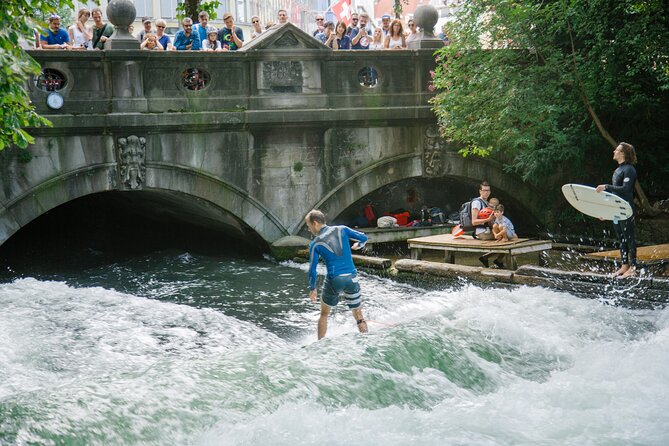
Near the Haus der Kunst, the Eisbach River forms a standing wave about one meter high. Experienced surfers ride it even though the water is cold and shallow. The tour stops for about ten minutes, usually long enough to watch the action and hear why the spot is famous.
The Eisbachwelle is one of Munich’s best examples of an ordinary city feature becoming a major attraction. You are not signing up to surf. The water conditions make it suitable only for experienced surfers, so treat it as a viewing stop.
The Friedensengel, or Angel of Peace, rises 38 meters above a point near the Isar. A six-meter statue of the angel crowns the Corinthian column, with fountains and steps below. The monument forms the eastern end of the sightline along Prinzregentenstrasse.
The Maximilianeum is another grand building along the route. It began as a home for a foundation supporting gifted students and has housed the Bavarian State Parliament since 1949. These stops show a more polished, civic side of Munich after the relaxed park and river scenes.
The Deutsches Museum is the final major museum preview. It contains about 125,000 objects from 50 areas of science and technology and is described as the world’s largest science and technology museum. Five minutes is enough to mark it on your map. Plan a separate visit if science, engineering, transport, or technology interests you.
Viktualienmarkt and Ohel Jakob Synagogue
Viktualienmarkt began as a farmers’ market and now has about 140 stalls and shops. You may find flowers, fruit, game, poultry, spices, cheese, fish, and juices. This is a better place than a formal monument for getting a sense of how Munich eats.
The stop is short, so you probably will not shop at length. Still, the market is worth remembering for a later snack or lunch. It also gives the tour a more everyday ending after so many palaces, museums, and official buildings.
Ohel Jakob Synagogue at Sankt-Jakobs-Platz is the main synagogue of Munich’s Jewish community. Built between 2004 and 2006, it was inaugurated on November 9, 2006, the anniversary of Kristallnacht. This is another serious and important stop, linking present-day Jewish life with Munich’s difficult past.
The route ends back at the meeting point. That makes it easy to continue into the center, return to your hotel, or use the tour’s restaurant and museum suggestions while they are fresh.
Is the electric bike worth the $71.90 price?
At $71.90 per person, the price is reasonable if you want a guide, a planned route, bike use, and a broad city introduction in one half-day. You are not paying for museum admissions, and the beer garden order is extra, but the tour covers a lot of ground without requiring you to arrange transport between districts.
The electric motor is most useful for riders who dislike hills, tire easily, or want to conserve energy for a long day of sightseeing. Several riders found Munich quite flat and said the motor was not strictly necessary because the route stops often. I would still choose it for comfort, especially in cold or wet weather.
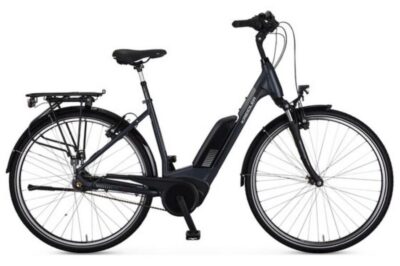
The listing says the electric bike and helmet are included, while some ride feedback describes standard bikes and electric bikes together, with the e-bike treated as an upgrade. Confirm exactly what your booking includes before you go. Either way, ask about the bike setup at the meeting point so you know what to expect.
The tour is booked about 61 days ahead on average, so popular dates may fill early. Free cancellation is available up to 24 hours before the start time. If the operator cancels because too few people book, you are offered another date or experience, or a full refund.
Who should book this Munich ride?
I would choose this tour for a first or second day in Munich, especially if you want history explained while you move. It suits families with older children and teenagers, couples, solo visitors, and anyone who likes seeing a city through several districts instead of spending four hours in one museum.
It is also a good choice for history buffs. The route gives you royal Bavaria, French influence, the Nazi period, postwar rebuilding, Jewish life, art, science, and modern city culture in one outing.
You should be comfortable riding in a city and staying with a group. One rider found a large group harder for a single guide to supervise on city roads. The tour is not just sitting on a bike, either. You stop frequently and may walk around sights, so reasonable fitness and mobility are useful.
Rain and cold do not automatically ruin the experience. The ride has gone ahead in poor weather, but wet streets and bike equipment can make it less pleasant. Check the forecast and dress for the conditions.
Should you book the Best of Munich Electric Bike Tour?
Book it if you want an efficient introduction to Munich with strong historical content, a relaxed beer-garden break, and enough local advice to plan the rest of your stay. The best guides make the difference, and names such as Canaan, Susanna, Rob, Karl, Mark, and Dan are associated with clear stories, good pacing, safety, and useful recommendations.
Skip it if you want long museum visits, a tiny private group, or a quiet ride with little traffic. For most first-time visitors, though, the route offers good value. You see far more than you would on foot, and the e-bike keeps the day from becoming a test of endurance.
FAQ
How long does the Best of Munich Electric Bike Tour last?
The tour lasts approximately four hours.
Where does the tour begin?
It begins at Karlsplatz 4, 80335 München, Germany.
Where does the tour end?
The tour ends back at the meeting point.
Is the tour offered in English?
Yes. The tour is offered in English with a live guide.
Is an electric bike and helmet included?
The tour information includes an electric bike and helmet. Some ride details indicate that standard bicycles may also be used in the group and that the electric bike can be treated as an upgrade, so confirm your exact booking details.
Are food and drinks included?
No. Food and drinks are paid separately, including anything ordered at Biergarten am Chinesischen Turm.
What happens if I need to cancel?
You can cancel up to 24 hours before the start time for a full refund. Cancellations or changes made less than 24 hours before the start time are not refunded or accepted.
New e-bike tours around the world
- Franschhoek: Private E-bike Ride & Wine Experience★ 5.0 · 6 reviews
- Franschhoek: E-Bike & Wine Tour (Shared Tour)★ 5.0 · 10 reviews
- Franschhoek: Explore The Valley Of Dreams With E-Bikes★ 5.0 · 7 reviews
- Frankfurt: Unique E-Bikes Tours★ 4.8 · 22 reviews
- Forte Dei Marmi: E Bike Tour and hidden gems with a local★ 4.7 · 3 reviews
- Private E-Bike Tour: Piazzale Michelangelo & Florence hills★ 5.0 · 5 reviews
- eBike Guided Tour of Fort Worth★ 5.0 · 4 reviews
- Formentera: discover our fast ferry + electric bike package.★ 4.4 · 51 reviews
Germany E-Bike Tours, side by side.
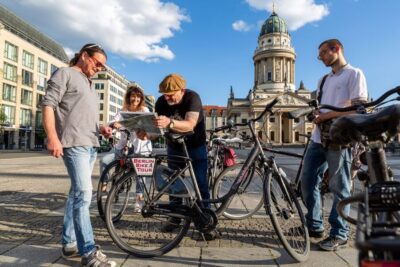
Berlin: E-Bike Tour of the Berlin Wall and Mitte Highlights
Read our review →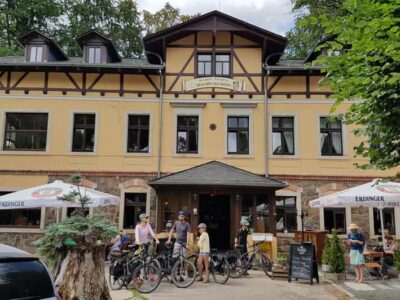
Dresden: E-Bike Tour and Dresden Heath Forest Trails
Read our review →
This ride also appears in