
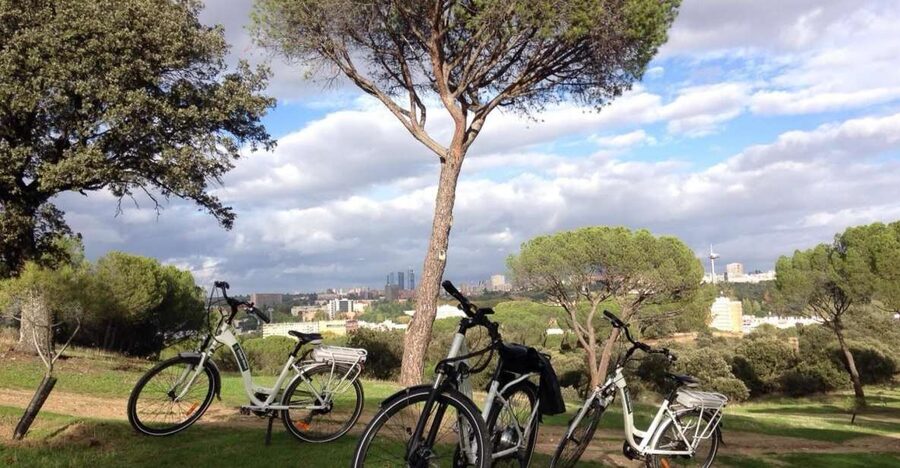
Review · MADRID
Madrid’s River Side & Casa de Campo Electric Bike Tour
Madrid’s best surprise may be how quickly the city gives way to woods. On this two-hour electric-bike ride, you pedal from the old center near Plaza Mayor to Casa de Campo, a huge former royal hunting ground with trails, a lake, Civil War trenches, and broad views back toward Madrid.
I like two things in particular: the route links major sights such as the Royal Palace and Cathedral with quieter green spaces, and the electric assist makes the long climb to the park’s high point manageable. The main caution is that you still ride on city streets and some parts are hilly, so bike fit, traffic comfort, and a working battery matter.
Key points to know before you book
- From Plaza Mayor to countryside in minutes: The route begins in central Madrid and quickly reaches the Manzanares River and Casa de Campo.
- A history lesson on two wheels: Expect Civil War trenches, old park constructions, bridges, monuments, and stories about Madrid’s past.
- The electric motor handles the hardest climb: You still pedal, but the battery assist takes much of the strain out of the uphill section.
- Seven bridges and palace views: The ride gives you changing views of Madrid’s architecture, including the Royal Palace, Opera House, Cathedral, and major bridges.
- Good guides make a real difference: David, Andrea, Nicolas, Pablo, Osmani, Gloria, and others have been praised for warmth, clear explanations, and calm handling of problems.
- Check the bike before leaving: Tall riders may need a larger frame, and several past outings required seat, handlebar, or battery adjustments.
Leaving the old city near Plaza Mayor
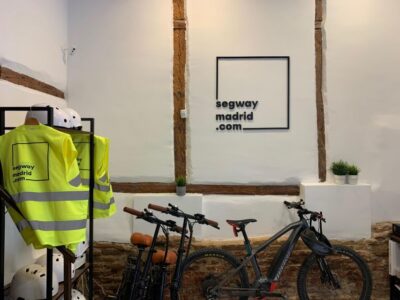
You meet at the local partner’s office, close to the center of Madrid. This is a useful starting point because you do not spend the tour being driven somewhere else. You begin among the city’s oldest streets, then ride toward Plaza de Oriente.
Plaza de Oriente gives you an early dose of grand Madrid. From here, you can take in the Royal Palace and the Opera House before moving on toward the Sabatini Gardens. The route does not treat these sights as isolated photo stops. Instead, they set up the contrast that makes the tour work: stone, traffic, and royal architecture first, trees and open ground later.
That change comes quickly. After passing the gardens, you take the long and steep San Vicente Hill. This is one of the spots where the electric motor matters. You must continue pedaling, but the assist helps turn a potentially tiring climb into a reasonable one.
I would still wear comfortable shoes and avoid treating the ride like a completely effortless sightseeing bus. You are operating a bicycle, watching the road, following the guide, and dealing with Madrid’s hills. The motor reduces the work, not the need to pay attention.
More e-bike tours around Spain:
- Barcelona 3-hour Bike or E-Bike Tour: Highlights and Hidden Gems
★ 5.0 · 1,429 reviews - Madrid: Highlights Bike Tour with Optional E-Bike or Tapas
★ 4.8 · 1,402 reviews - Barcelona: 2.5-Hour Bike or E-Bike Historical Tour
★ 4.5 · 1,262 reviews
Crossing the Manzanares into Casa de Campo
The route reaches the Manzanares River, which you cross on the way to Casa de Campo. This is the tour’s big change of mood. In a few minutes, the dense center feels far away, and the ride begins to feel more like an outing beyond town.
Casa de Campo was once reserved for kings and nobles who hunted here. Today, it is a popular local recreation area. The park’s small lake is a lively weekend spot, with rowing boats and barbecues. The setting gives you a look at how people in Madrid use their city, not just how historic buildings are presented to tourists.
The park is the reason to choose this experience over a standard central-city bike circuit. You get trees, paths, open views, and a break from the hard surfaces of central Madrid. Edith described the park ride as lots of fun, while Susan valued the chance to get away from the streets and see this side of the city.
Do not expect every meter to be a quiet woodland trail. The route begins and ends on urban roads, and one detailed account found more riding beside vehicle traffic than expected. If you are uneasy on streets, ask about the route and safety instructions before setting off.
Climbing to Madrid’s highest view
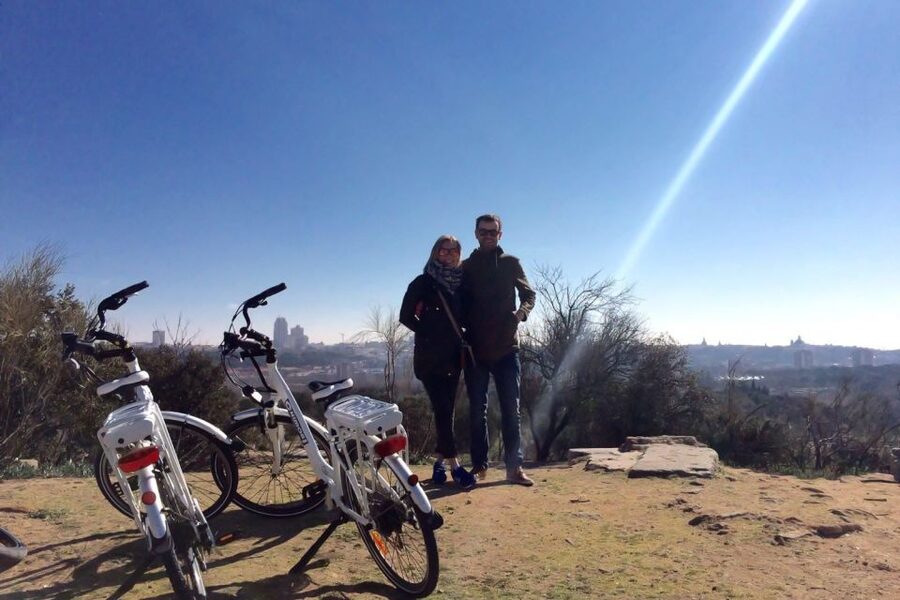
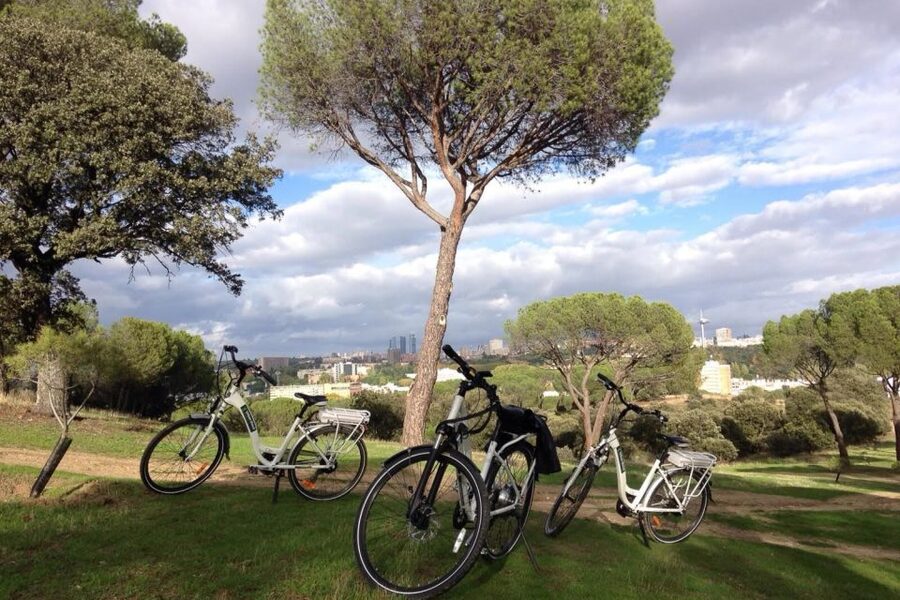
Inside Casa de Campo, the e-bike helps you climb toward the park’s highest hill. This is the physical high point of the tour and one of its best rewards. From above, Madrid spreads out in a way that is hard to understand from street level.
You get a skyline view after moving through the trees, so the city feels newly revealed rather than constantly in front of you. The guide normally allows a short rest here. That pause is welcome, especially on a hot afternoon, and it gives you time to take photos without trying to steer at the same time.
The electric assistance was particularly useful for older riders. A couple in their seventies completed the ride with ease, while another rider over sixty found that choosing a smaller, lower bike did not work well on the climbs. That is a practical lesson: a low frame can feel reassuring at first, but the correct size and a strong e-assist setting are more important than simply choosing the easiest bike to mount.
Ask staff to set the saddle and handlebars carefully before leaving. One ride needed repeated adjustments, including a crooked handlebar, and another bike lost its electric assist near the end. These problems were handled, but they show why a short equipment check is worth your time.
Bridges, trenches, and Madrid’s wartime past
The ride is not only about scenery. Your guide points out trenches built during the Spanish Civil War, along with other structures connected to the park’s past. These remains give Casa de Campo a harder edge. It is not simply a pleasant green escape. The paths pass through a place that has seen conflict as well as leisure.
The quality of the explanation depends partly on your guide, and the named guides connected with this experience have generally made the history a strong part of the outing. Andrea adapted a private ride to include historical points, and Gloria used nearby statues and monuments to keep the conversation going while a replacement bike was arranged. Osmani was praised for being calm and informative, while David was described as caring, friendly, and professional.
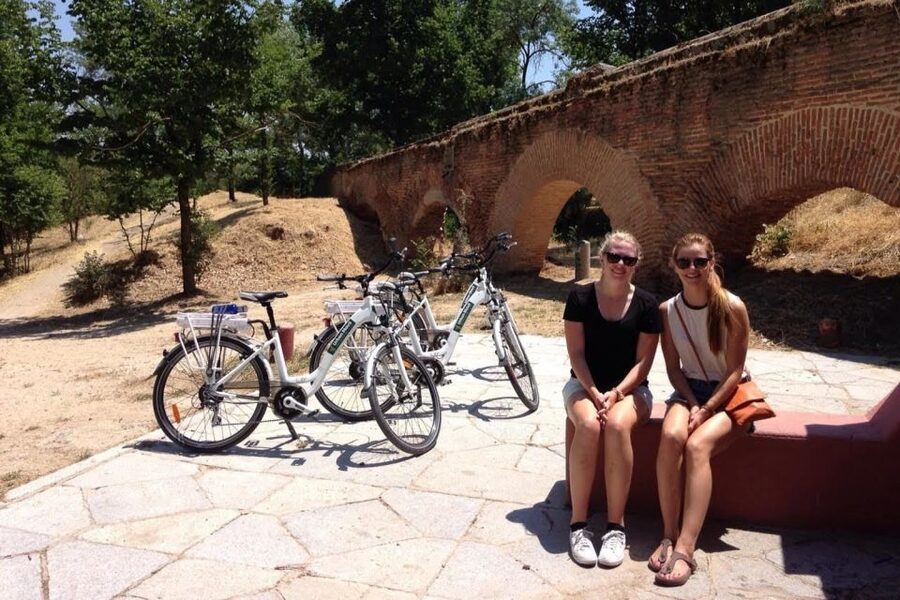
The city views also include seven major bridges. You may not study each bridge in the same way you would on a dedicated architecture tour, but together they show how Madrid connects its center with the river and western parkland. The bridges add structure to the ride, while the paths through Casa de Campo provide the breathing room.
A guide matters here because the park’s remains can be easy to pass without context. You can pedal past a trench or bridge on your own, but a good explanation tells you why it is there and how it fits into Madrid’s story.
Same saddle, a different route:
- Seville: Highlights City Bike Tour
★ 4.8 · 2,168 reviews - Albaicin & Sacramonte Electric Bike Tour in Granada
★ 5.0 · 1,044 reviews - Barcelona: Sagrada Familia or City Tour by Bike or eBike
★ 4.8 · 928 reviews - Granada: Albaicin and Sacromonte E-Bike Tour
★ 4.9 · 852 reviews
Finding Madrid’s beach and the Serpents Bridge
The itinerary includes Madrid’s so-called beach along the river. The city is inland, of course, so this is not a seaside stop. It is a riverside recreation area, and the name reflects how locals use the riverfront for leisure.
The Serpents Bridge is another memorable construction along the route. Its design gives the ride a small architectural surprise after the broad park views. It is the sort of stop that works well by bike because you can reach several different points without spending much time retracing your steps.
At this stage, the route shows why the title promises more than a park ride. You see royal architecture, river engineering, bridges, a recreation zone, wartime remains, and woodland paths in one compact outing. The variety is the selling point.
The descent through Huerta de la Partida
After the uphill section and the pause at the viewpoint, you begin descending toward the river. The return through Huerta de la Partida brings the city back into view, including the Cathedral and Royal Palace.
This is a particularly good final stretch because it combines the green edge of Madrid with the city’s most recognizable buildings. You are not simply retracing the opening route. The descent gives you a different angle and a sense of having crossed a real boundary between center and countryside.
The guide may also point out small churches, statues, and monuments along the return. One private outing included a small church associated with Goya, adding another cultural detail to the route. The precise stops can change with group size and timing, especially if the guide needs to deal with equipment trouble or adjust the ride for the people in the group.
The advertised duration is two hours, but the timing is approximate. It may run a little shorter or longer. That is worth remembering if you have a museum reservation or train departure immediately afterward.
How much work is the electric bike?
The e-bike is pedal assist, not a motorbike. The battery helps as you pedal, especially on the San Vicente Hill and the climb inside Casa de Campo. You still need basic cycling ability, balance, and enough confidence to ride around other road users.
This distinction matters. One participant specifically advised making sure you can ride a bike before booking. That is sound advice. The tour is designed to reduce exertion, not to teach cycling or remove every physical demand.
The route received strong praise for being relaxing and manageable, including from older riders. At the same time, battery problems affected a few outings. One bike stopped assisting uphill, and a replacement bike was needed in another case. Guides dealt with these situations calmly, but you should check that the battery is active before leaving the office.
Helmets are included but not mandatory. I would wear one, especially because part of the route uses public streets and helmets are not automatically required for every participant. Baskets, locks, raincoats, and a central Madrid map are also provided.
The guides can shape the whole experience
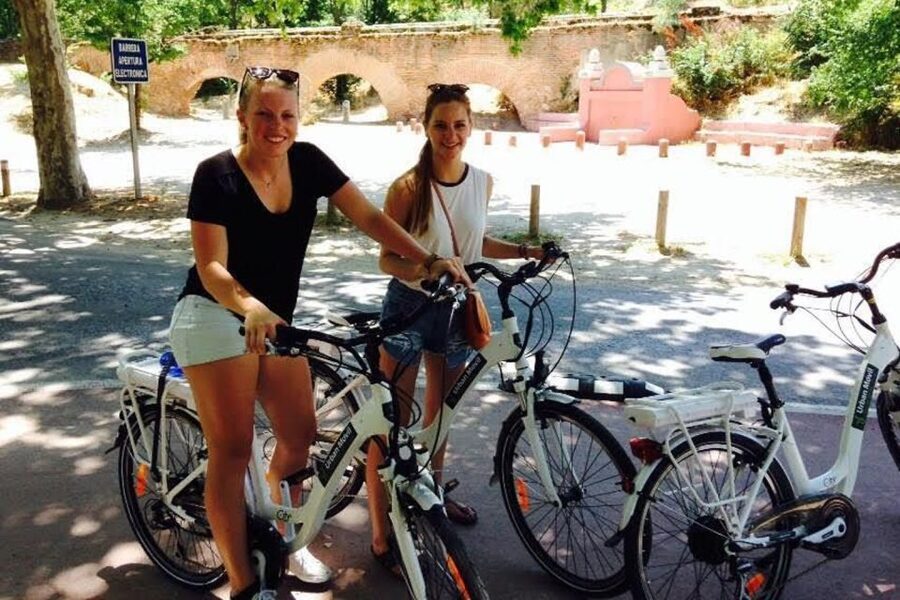
A bicycle tour is partly a route and partly a conversation. The guide sets the pace, explains the sights, keeps the group together, and decides how much time to spend at each stop.
The guides named in the feedback were a real strength. David was described as caring and friendly. Andrea gave historical explanations at several points on a private ride. Nicolas was praised for his professionalism, help with water on a very hot day, and calm response when a bike failed. Pablo, Jonny, Osmani, Bo, Gloria, and Borja also received warm comments for their history, patience, or friendly manner.
The guide can also adapt the experience when the group is small. One person had the guide to themselves, allowing the route to avoid attractions already visited and focus on other parts of Madrid. A larger group may feel less flexible, so ask about availability if you are booking for several people.
English and Spanish are the standard languages. Other languages may be available if requested, but you should arrange that in advance rather than assume it on the day.
Price, comfort, and who gets good value
At $46 per person, this sits in a reasonable range for a guided two-hour activity that includes the electric bicycle, helmet, guide, rain protection, basket, lock, and map. The value comes from combining central Madrid with Casa de Campo in a short time. Doing the same route independently would require finding the way, hiring equipment, and researching the historical stops yourself.
I would call it especially good value if you have only a few days in Madrid and want to see more than the central monuments. It also suits people who like active sightseeing but do not want a hard cycling workout.
The value is weaker if your main goal is a slow palace visit, a quiet woodland walk, or a completely traffic-free ride. You will not spend two hours inside Casa de Campo. The tour is a city-to-park loop, and that means some road riding and a brisk pace between stops.
Wear a sun hat and sunscreen in warm weather. July and other hot periods can be demanding, so bring water and use the rest stops sensibly. Comfortable shoes are required, and large bags or luggage are not allowed. Pets and smoking are also not permitted.
Should you book the Madrid River Side and Casa de Campo Electric Bike Tour?
Book it if you want a fast change from city streets to open parkland, enjoy hearing local history while moving, and feel comfortable on a bicycle. It is a smart choice for first-time visitors who want palace views, bridges, river scenery, Casa de Campo, and a skyline lookout without spending a full day on an excursion.
I would be more cautious if you are a nervous cyclist, very tall and unsure about bike sizing, or expecting a route made entirely of separated paths. Ask staff to size the bike properly, test the electric assist, and wear the helmet provided.
The strongest reason to choose this tour is its range. In two hours, you get royal Madrid, the Manzanares, a former hunting park, Civil War remains, Madrid’s river beach, and a high view over the city. That is a lot of ground, and the e-bike makes it possible without turning the outing into an endurance test.
FAQ
How long does the tour last?
The scheduled duration is two hours. The timing is approximate, so the tour can be slightly shorter or longer.
How much does the tour cost?
The listed price is $46 per person.
Where does the tour meet?
You meet at the local partner’s office. The starting area is in central Madrid, close to Plaza Mayor.
Which languages are available?
The tour is offered in English and Spanish. Other languages may be available upon request.
Is the electric bike included?
Yes. An electric bike is included in the tour price.
Is a helmet provided?
Yes. A helmet is included, although wearing it is not mandatory.
What sights are included along the route?
The route includes Plaza de Oriente, the Royal Palace, the Opera House, Sabatini Gardens, the Manzanares River, Casa de Campo, seven major bridges, Civil War trenches, Serpents Bridge, Madrid’s river beach, Huerta de la Partida, and views of the Cathedral and Royal Palace.
Do I need to be able to ride a bicycle?
Yes. The electric motor assists your pedaling, but you still need to ride and control the bicycle yourself.
What should I bring?
Bring comfortable shoes, a sun hat, and sunscreen. Large bags and luggage are not allowed.
Can I cancel the booking?
You can cancel up to 24 hours in advance for a full refund. A reserve now and pay later option is also available.
New e-bike tours around Spain
- Formentera: discover our fast ferry + electric bike package.★ 4.4 · 51 reviews
- Estepona: Private premium eBike tour★ 5.0 · 2 reviews
- Electric mountain bike in Sierra de las Nieves national park★ 4.6 · 5 reviews
- Torrevieja: Natural Parks e-Bike Tour★ 3.6 · 18 reviews
- Electric Bike Tour of Montjuic and Barcelona★ 5.0 · 6 reviews
- Electric Bike Adventure through Cartagena★ 5.0 · 5 reviews
- Caminito del Rey Full Experience+ 2-Hour E-Bike guided Tour★ 4.9 · 20 reviews
- From Barcelona : E-Bike across Girona Province & Costa Brava★ 4.7 · 3 reviews
Madrid E-Bike Tours, side by side.
Madrid City Guided Bike/E-Bike Tour for Small Groups
Read our review →
All Madrid: Private Electric Bike Tour around the city
Read our review →This ride also appears in